
Recurring tasks
Create independent tasks on a fixed schedule or after completion, with editable occurrences for routines and ongoing work.
IntermediateRecurring Tasks in Herculean provide two flexible ways to manage work that needs to be repeated regularly.
When a recurrence is triggered, Herculean automatically creates a new task in your project’s Backlog, using the title and description defined in the recurring task’s template. The recurrence itself also has its own title and description, allowing you to document its purpose separately from the tasks it generates.
Unlike a simple recurring reminder, each occurrence becomes a fully independent task. It appears on your board, contributes to your productivity statistics and can be managed through the same workflows, AI integrations and labels as any other task.
Because Herculean is designed around individual productivity, it supports two approaches to recurrence:
- Time-based recurrence: Tasks are generated at regular intervals, regardless of whether previous occurrences have been completed. Ideal for work that must happen on a consistent schedule.
- Completion-based recurrence: A new task is generated when the previous occurrence is marked as complete. Ideal for activities where the next task should only become available after the current one is finished.
This distinction allows you to manage both fixed commitments and activities that repeat according to your progress.
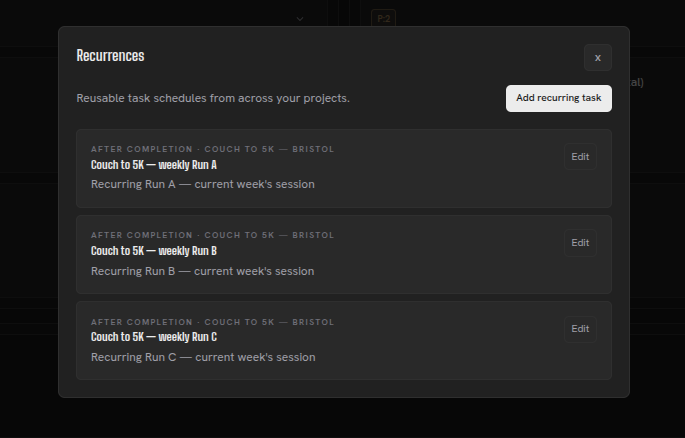
Recurring Tasks ensure that repeated work remains visible, measurable and actionable, without requiring you to recreate the same tasks manually.
Tasks generated by recurring tasks are regular Herculean tasks, complete with labels, descriptions and AI integration.
This means you can use recurring tasks to schedule repetitive work for your AI agents, using labels and instructions to tell them what needs doing.
Combined with connected AI automation, recurring tasks become a simple but powerful way to orchestrate repeated AI workflows without manually creating or organising the work each time.
Every task created by a recurring task is independent, meaning you can update its title, description, intensity and other task details without affecting future occurrences.
For example, a recurring running task can act as a blank slate for recording each run’s distance, time and intensity, as in this Couch to 5K training plan, while future tasks continue using the original template.
This makes recurring tasks ideal for tracking activities that repeat regularly but have different results each time, allowing you to build a useful history of your progress.
Fixed schedule
The simplest type of recurring task in Herculean is Fixed Schedule Recurrence.
This works much like recurring tasks in traditional task management systems. You define an interval, such as every seven days, two weeks, one month or one year, and Herculean automatically creates a new task in your project’s Backlog whenever that interval is reached.
The important distinction is that each recurrence operates independently of previous tasks.
It doesn’t matter whether the previous task has been completed, remains In Progress or is still sitting in your Backlog alongside several earlier occurrences. When the next scheduled interval arrives, Herculean creates another task.
This makes Fixed Schedule Recurrence ideal for commitments that must happen regardless of whether you’ve completed the previous occurrence.
Examples include annual tax returns, birthdays, quarterly financial reporting, monthly accounting and other unavoidable, time-based responsibilities.
Because generated tasks can also inherit predefined labels, they remain accessible to your connected AI agents, allowing them to identify upcoming commitments, organise the necessary work and help you stay on schedule.
Fixed Schedule Recurrence is designed for work that needs to happen when it’s due, whether you’re ready for it or not.
Completion-Based Recurrence
Herculean also supports Completion-Based Recurrence, where a new task is created only when the previous task is completed and moved to Done.
This works particularly well with deadlines. When you complete a task, Herculean creates the next occurrence with a fresh deadline based on your configured interval.
It’s ideal for ongoing maintenance activities such as exercise, where consistency matters but rigid schedules aren’t always practical.
You can finish early, take a break, recover from illness or injury, or simply let a deadline pass without accumulating duplicate tasks.
For example, you might configure a recurring running task with a seven-day deadline. Complete it early, and the next task appears with a new deadline. Take three weeks off, and you’ll return to just one outstanding task rather than a backlog full of missed runs.
This gives you the flexibility to work at your own pace while maintaining a consistent routine and tracking each completed activity.
Completion-Based Recurrence keeps you moving forward without punishing you for taking a break.
Related content
Continue with other guides and examples connected to this topic.
Couch-2-5k
A full running plan for 16 weeks leading to a 5k run in Bristol, UK
BeginnerDependencies and diagrams
Link prerequisite tasks across projects and explore how work connects in an interactive dependency graph.
AdvancedNew Tab
Review selected Herculean projects or tasks in your browser's New Tab, check local weather, or search and prepare an AI prompt.
Beginner