

Herculean is perfect for scheduling personal regimes such as regular exercise or personal challenges, goals or accomplishments. As it’s built for the individual it’s ideal for managing the routine and intensity required for the individual to plan, track and complete their goals.
In this example we set up a full Couch-2-5k plan over 16 weeks, including the objective to find and attend a 5k run in Bristol, UK at the end of the training. Yes, real research into real runs are part of our full project plan.
The prompt was passed to OpenAI Codex running GPT-5.6 Luna on High reasoning settings. As a straight forward plan and task a simple, disgustingly cheap model like Luna can easily create the full project plan and link to the easily available research.
Our Prompt
Create a realistic Couch to 5K project for someone who currently does very little running and wants to be able to complete a continuous 5K comfortably after roughly nine weeks.

Build a progressive plan that averages out to three running sessions per week, appropriate recovery/rest between sessions, simple mobility and preparation work and weekly progression milestones. Use recurring tasks or recurrence where it makes sense rather than manually creating repetitive generic tasks.

Include initial preparation such as choosing suitable running shoes, selecting safe local routes, deciding how progress will be tracked and optionally choosing/registering for a 5K event near the end of the programme. The location of the runner is Bristol, England. Research the appropriate running events available at 16 weeks from the current date of 24/9/2026 and add them into the task.

Keep the project approachable for a beginner and focused on habit-building and completion rather than competitive performance.
I’ll research Bristol 5K options around 14 January 2027, then create the project with recurring run/recovery tasks, weekly milestones, preparation tasks, and dependencies. I’ll keep the plan beginner-focused and conservative, with a note to stop and seek clinical advice if pain or health concerns arise.
The structure is set: a nine-week progression based on the NHS beginner model (three runs weekly, rest days between, five-minute warm-up/cool-down), plus a small post-programme runway so an event 16 weeks out remains optional rather than forcing a race into week nine. I’m adding the recurring session series and the weekly progression milestones now.
The recurring series are confirmed: three separate weekly-after-completion sessions in Europe/London, each carrying the recovery/safety guidance. I’m checking the final dependency graph before I hand it over.
• Created Couch to 5K — Bristol in Herculean.
It includes:
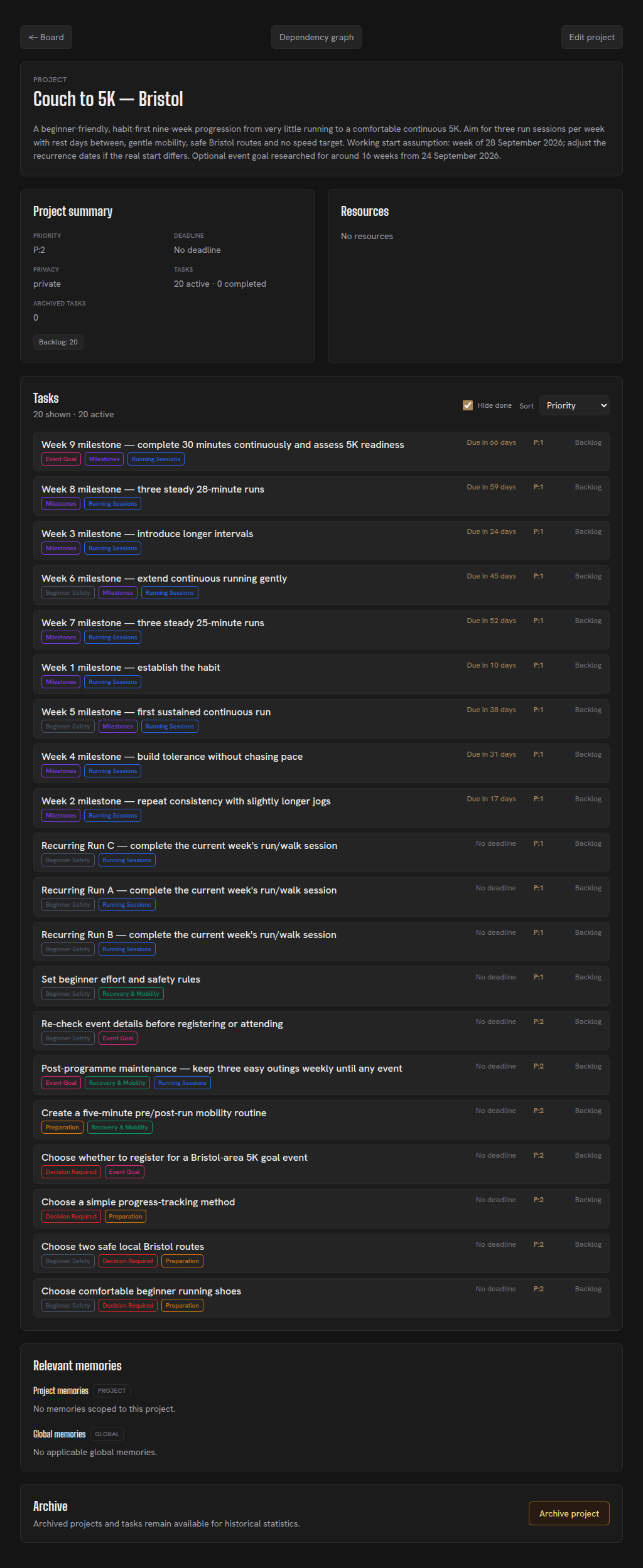
- 20 tasks, 30 dependencies and 7 beginner-focused labels
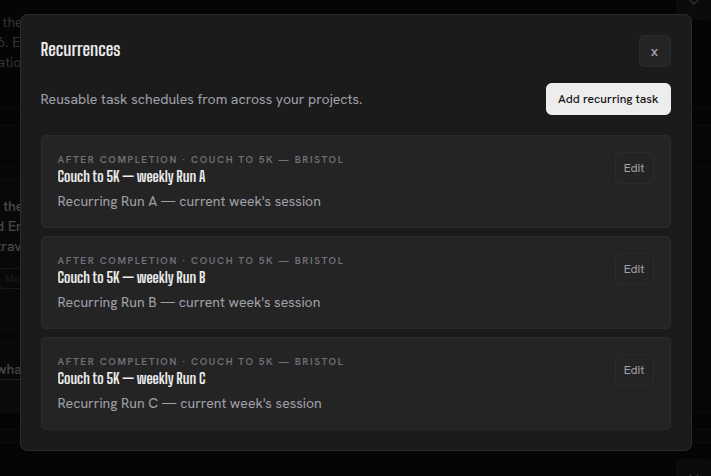
- Three separate weekly recurring run series—Run A, B and C—triggering the next session after completion
- Nine dated weekly milestones, assuming a start during the week of 28 September 2026
- At least one rest day between sessions, five-minute warm-up/cool-down guidance and optional mobility
- Shoe, route, safety, tracking and event-preparation tasks
- A post-week-nine maintenance task so the January event remains optional
- Beginner safety guidance and permission to repeat a week
The progression follows the NHS model of three weekly runs over nine weeks, with alternating run/walk intervals progressing toward 30 minutes continuously. NHS Couch to 5K guidance (https://www.nhs.uk/better-health/get-active/get-running-with-couch-to-5k/couch-to-5k-running-plan/)
The event task includes:
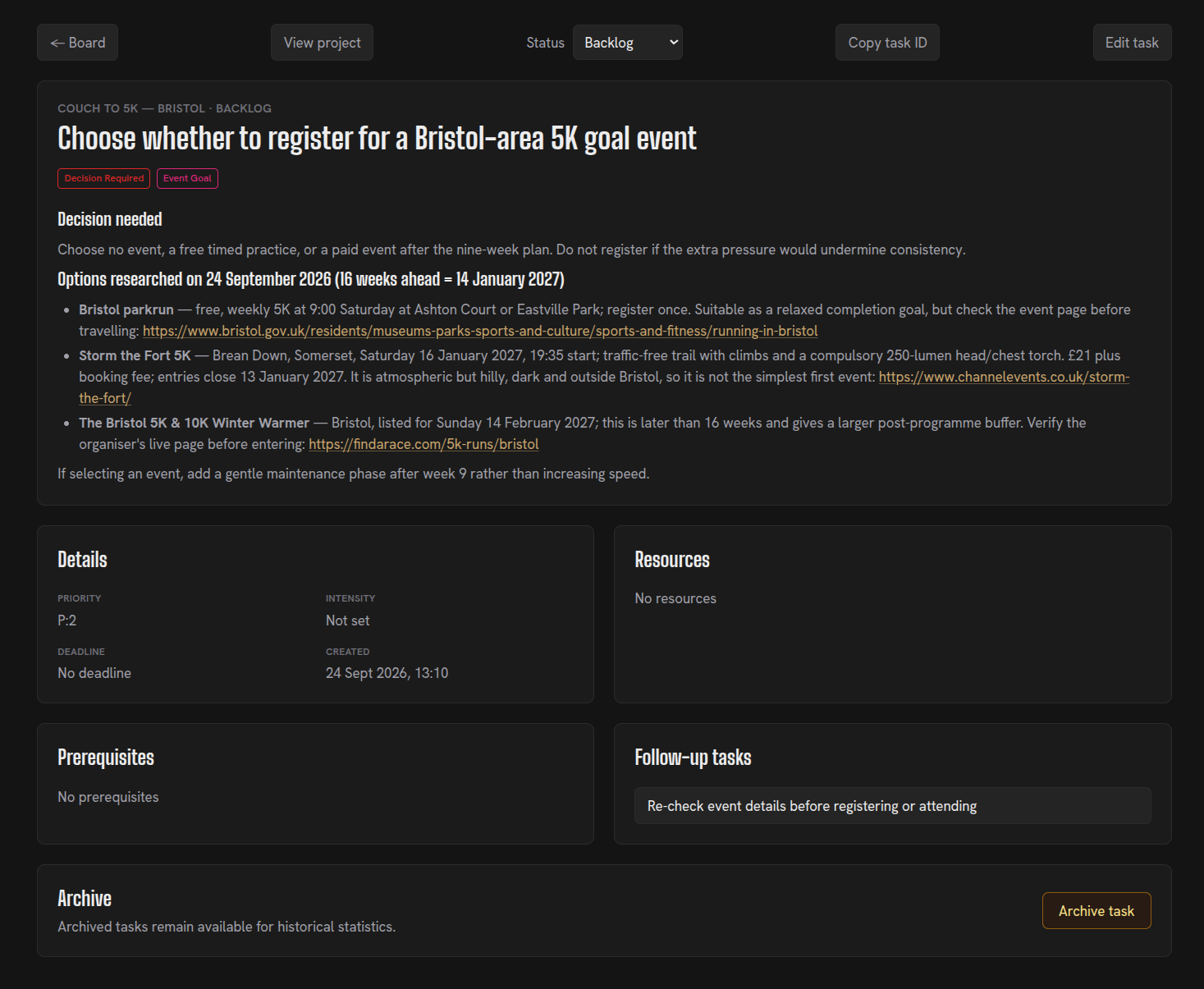
Bristol parkrun at Ashton Court or Eastville Park—free, weekly Saturday 5Ks. Bristol City Council (https://www.bristol.gov.uk/residents/museums-parks-sports-and-culture/sports-and-fitness/running-in-bristol)
Storm the Fort 5K, Brean Down, 16 January 2027, with hills, a night start and a required 250-lumen light. Event organiser (https://www.channelevents.co.uk/storm-the-fort/)
The Bristol 5K & 10K Winter Warmer, listed for 14 February 2027, giving a larger buffer after the nine-week programme. Event listing (https://findarace.com/5k-runs/bristol)
View the Herculean dependency graph (https://web.herculean.chat/dependencies/projects/01a0d351-a258-7d9f-9ef3-5aa844b7c6b1)
Resulting board
Within 3m 8s the AI had integrated with Herculean and produced a full project with 20 tasks, all dependencies and 3 regular recurring training runs, each set to recreate once the prior training run had completed.
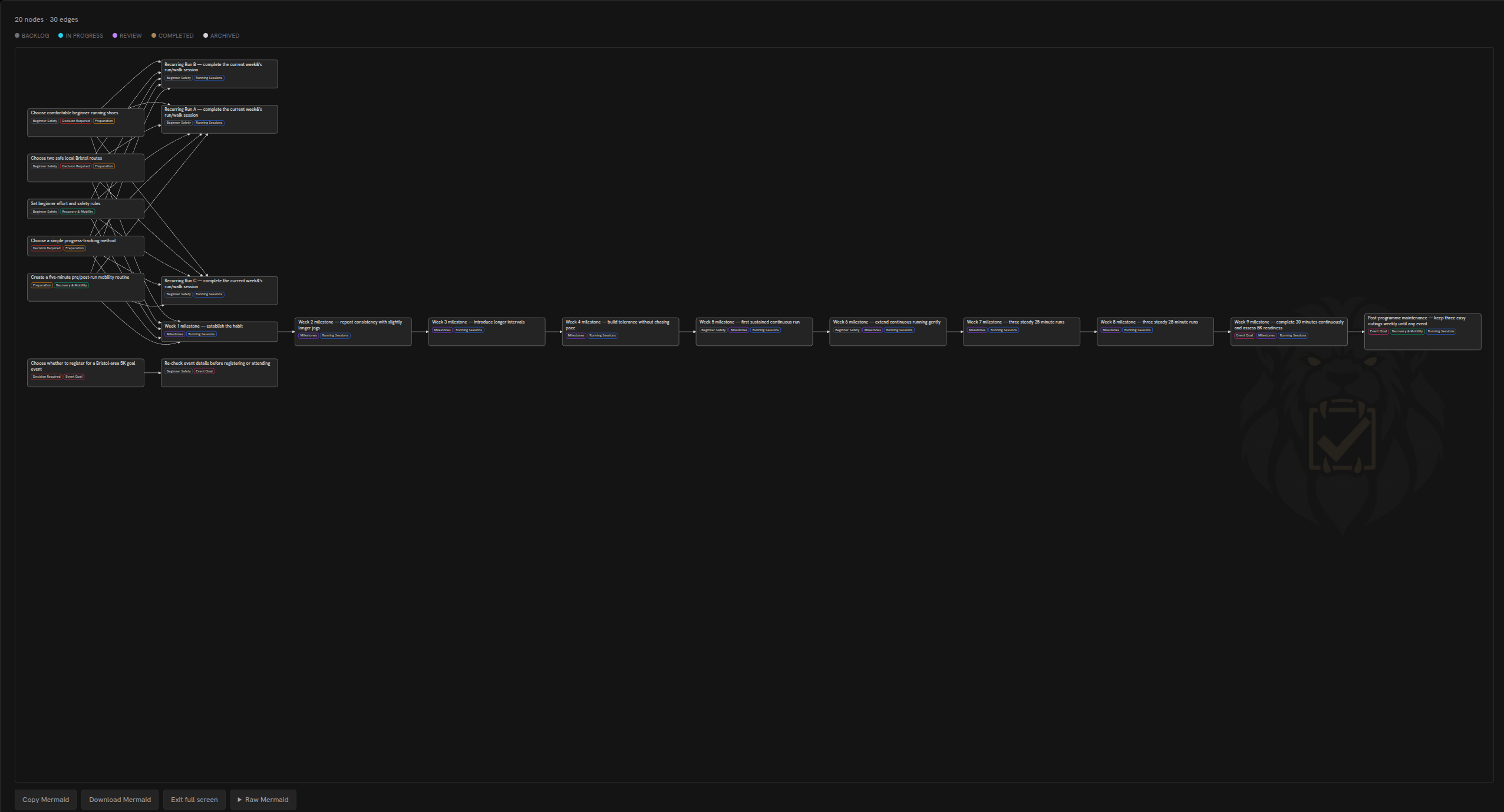
Additionally, the dependencies were fully linked allowing for a full dependency view starting with the initial work setting up the schedule, to mapping each milestone and linking the dependencies between booking the end run and attending the event.
Recurring tasks were added to repeat runs. They’re set to allow for you to complete each A, B or C run independently rather than sticking to a strict calendar event. If the beginner slips on a run or completes one early then the board will adjust dynamic rather than continuously stack up reminders.
In the final move, our AI has created a task to determine which of the races we’re going to enter, having researched and implemented the various options available in Bristol, UK around 14th January 2027.
The Advantage
This example took less than 5 minutes to generate the full Couch-2-5k training plan using a budget model. All the research was done for you and a full plan including your milestones set up in Herculean with the appropriate dates and deadlines made available.
Now on the plan you can move your milestones over to done as you hit them, track your runs as individual tasks whilst the recurring tasks keep your backlog topped up with your next set of runs.
On this page
Related content
Continue with other guides and examples connected to this topic.
International House Move
Using Herculean to plan an international move
IntermediateUK Limited Company Setup
A full guide to UK company setup for a personal trainer covering taxation, governance and more
AdvancedMemories
Store global or project-specific context, instructions, and preferences for connected AI agents to retrieve when relevant.
Advanced